
EDITOR'S NOTE
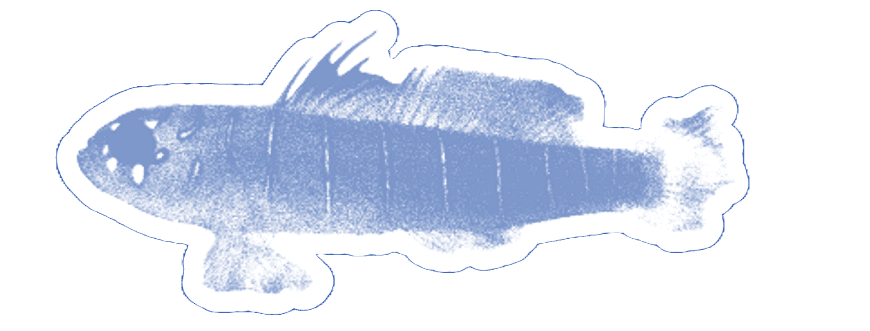
I first came across the blue banded goby on Catalina Island as a part of a month-long creative writing retreat led by Dr. Katharine Ogle (shoutout!) who received her PhD in Literature and Creative Writing from the University of Southern California. The blue banded goby (Lythrypnus dalli) is a species of fish capable of bidirectional sex change, developing male or female sex organs depending on its social environment. (Research on the blue banded goby is currently being conducted by Dr. Devaleena S. Pradhan at the USC Wrigley Marine Science Center.) Its sexual fluidity challenges human notions of fixed gender binaries. Here, we seek pieces that transgress boundaries and occupy liminal spaces — hence, The Goby Review.
In this issue, you will find pieces pushing the limits of form and language. You will find poems in a constant state of flux, shifting between states without ever settling on a definite answer. Starting us off, we have Ava Shu’s MULTIPLE CHOICE QUESTIONS (ON HOW TO BE A GOOD GIRL). The addressee in the poem is one and many: “he / she / they / I / will drive this story to the edge of every cliff / & keep driving until you find the end of the / sun / soil / basin / bedroom ceiling.” Through the format of a multiple choice test, Shu explores the multiplicity of meanings inherent their every action as they “become and become / & keep becoming—”
These are works that interrogate identity. In Con Suéno, Anya Jimenez embarks on a exploration of her genealogy. Incorporating images of American violence from the present and the past, she ruminates on the enormity of her Cuban’s grandfather's sacrifices: “Jimmy, I am sorry you rained fire over Korea / To one day have an American grandbaby who never learned how to go to sleep.” In A Piece of the Cosmic Race, Omar Mejia is “caught between two worlds, / One of triumph and of despair” as he fights to honor his ancestry amidst the bloody history of the United States. “I am my history and my history is I,” he writes, “My heritage is that of a cultural revolution.” Similar to Mejia, John Recendez finds himself at a crossroads, attempting to preserve his indigenous heritage against his subconscious desire for approval from Western institutions: “I think about how I’ve been self-domesticating / As the city trims parts of me like it trims its wildflowers.” Incorporating Isthmus Zapotec throughout the poem along with a plethora of other languages such as Greek, Spanish, and Korean, Recendez weaves a rich tapestry of cultures in defiance against the idea of America as a monolithic, white country. In 白鹭 / White Heron, Hanna Liang wields the transformative power of language to craft her own narrative as an Asian American immigrant. She masters "the art of misnaming [her] mother’s favorite bird,” to carve her own “白路” (white road, pronounced the same as white heron) “with a foreign tongue.”
These are works that find themselves in unlikely places. In Those Birds Still With Us, Susan Mccabe traverses space and time, “passing down the line of trance” from Homeric “salt sea circles… parting for Circe” to the “Grand Depository,” a library located next to the University of Southern California. In Witch!, Gabriela Rey takes us through soot and candlelight to the Salem Witch Trials, relaying the age-old story of a woman being scapegoated by a misogynistic, patriarchal society: “I knew I would be punished for my sins. But I did not know it would come from my own father.” Shane Alison situates Gunslinger Knees “On the tiles of mall bathrooms, or in the earth of some cruisy park.” With his sharp, witty language, he crafts a deft picture of the chronic pain: “But right now, my knees are like two gunslingers / At high noon shooting it out until the other falls.”
These are works that go mad with obsession. Shristuti Srirapu’s green eggs and ham is desperately romantic, but its diction borders on violence: “we gorge ourselves on pixie dust / and wet dreams and then tell / each other we cannot be broken.” The speaker is so deeply entranced that they would gladly “rot / in the woods and drown in the lake / and then some” just to be with their lover. Simone Wesley traces a similar path of ravenous longing in Doesn’t Matter. Midway through, the speaker collapses into a string of incoherent babbles: “Eat until I understand Understand until I cannot eat Eat hunger something Is under hunger is.” The immensity of their desire is geological: “I will paint you on rocks Like my hands aren’t Millions Of years old Mashing pigments To color My vision of you Iron.” Only in the final line does a hint of clarity come through: “Still you.”
These are works that go bleary eyed with loss. In Trash by Mitchell Jacobs, the speaker finds marks of his lover everywhere: even on “meaningless things” like “Disposable contacts. Wadded tissue speckled with excess earwax. / Beard clippings clinging to the soap dispenser.” The poem grapples with the idea that although these pieces of “junk” is gross and arbitrary, they are hard to toss in the trash because they still contain some imprint of the person now absent. Regina Duran renders grief with vivid detail. Every line in her poem is a dedication: “your snowy mustache tickling / my cheek tired rough hands / ruffling my hair callouses older / than me.” For Duran, loss is not only an emotion but a tangible suffocation: “I still smell / your cigarette / smoke / every where / I go.”
These are works that yearn for rebirth. Akpezi Ogbaudu’s Hikari slips us into the boundary between life and death, where the speaker is both young and ancient, nameless and faceless: “my heart is as young as a new bird’s, freshly broken from the egg, wet, and eyes clamped shut from the sharp rays of the sun.” Ogbaudu’s descriptions are reminiscent of the cosmic egg, a mythological motif across many cultures where the universe begins with the hatching of an egg. In Graduation Song, we break free from the gravitational pull of stars that once bound us. Charlie Wei renders the elation of graduation with language supernova-violent and full of possibility: “We could leave the ellipse and / stray ourselves into something stellar, a planetoid hotter / than those circuits, a ringlet spanning longer / than saturn, a death from a collision larger / than this city god we are always so much more than / what they bound us to.”
These are works that deal with uncertainty. In Amongst Janitors, Albert Abdul-Barr Wang relates the “dull ache of complicity” that the main character, Saira, feels for having her artwork featured at a gallery that subjects its workers to awful conditions. Even after the janitors’ strike succeeds, Saira cannot help but feel skeptical: “In her chest, something loosened, not into triumph, not into righteousness, but into a thin, uneasy tenderness that felt dangerously close to hope, and she distrusted it immediately, because hope can be a narcotic too, a way of forgetting the morning after.” In our final piece, The Only Solid Thing in Heaven, Amy Jong addresses a person caught in a plane where souls “are always morphing into what they next want to be: a dandelion hair, the wisp of a cotton ball, a fraying edge.” Jong grapples with the impossibility of language to fully convey emotion: when the addressee wakes at the end of the piece, they reel at “the absurdity of having but one stumbling tongue to articulate" what they have just experienced.
Oftentimes when I am writing, I feel as if I am chipping away at stone with language as a crude, rusted implement. Sometimes I unearth a gem — a brief epiphany — before it dims and I am left again to grope about in the dark. However, regardless of what absurdities we meet, we must continue to write — to articulate and interpret the world around us.
Hanwen Zhang is a student studying Cognitive Science at the University of Southern California and the founder of The Goby Review. He likes writing, thinking about writing, talking about writing, choral music, running, and soup. His work has been published in Palaver Arts Magazine and Haute Magazine.